
Throwback Thursday

Throwback Thursday

A tricitaxi is perfect for navigating a small town! I wish I had one here!

one of my favorite pictures from Mexico
I love watching House Hunters International. There. I’ve said it. Don’t judge me. The people who have a budget of a million dollars are so far out of my league that I just can’t relate to them. I am happy they have that much cash to spend, but at the same time, it is not—for me—a realistic budget.
I have news hot off the press for these rich folks. I can find them a presentable house (in Mexico) for MUCH less. The Mexican price is not the same as the American price for a house. You just have to know where to look. If you go to the real estate ads online, be sure you will pay the American price. There are some pretty houses (for a pretty price). Many have a few acres too, BUT wouldn’t you rather find a little jewel for a great deal? Do you really need a hacienda to be happy?
The episodes I can’t get enough of include regular, working folks who have a realistic (to me) budget and are looking for that one special home, perfect or not. Like me, they will search for a home with “rustic charm” and “good bones.” I can definitely relate to those people. After all, what’s wrong with doing some upgrades and not paying top dollar? That’s what we did when we moved from the States to Mexico. I still love that house. 🙂 The best part? It was WAY under a cool million.

our humble Mexican abode

Writing Challenge
I have done both. I don’t mind going alone. That’s what happened when I scheduled a trip to Costa Rica when I was in college. None of my friends had the money or the determination to make the trip, but I planned for a year to be able to go. It was an amazing adventure. (My mom calls me a daredevil!) I met a very nice man (Eduardo) on the plane who got us a taxi when we landed while I guarded the luggage. I hadn’t made hotel reservations, so Eduardo told the driver where I needed to be. I asked for “cheap and clean.” The hotel was in the Zona Rosa (red light district), but it was fine. I felt safe there because Pancho (clerk/receptionist) always kept an eye out for my safety. He wouldn’t let me go out alone even though I thought I was perfectly capable of protecting myself. He would find out where I wanted to go and search for another guest going the same place. I remember playing cards with Pancho and two other guests almost every night. One guest spoke Greek, Arabic and some English, another spoke Albanian and some Greek, Pancho spoke only Spanish. Luckily, I completed the circle with English and Spanish. The Albanian guy would say something in Greek which was translated into English. I then would tell Pancho what was going on. If it was a joke, the guys waited for the final translation before they laughed.
I have traveled with my older daughter. When she was about 10, we went to Puerto Rico for a week. We had a great time (if you don’t count an ear infection from the pool). We both learned a lot on that trip. It was memorable also because one of my very best pals “decided” to have a heart attack while my back was turned! I was ready to get on a flight home, but she was well enough to tell me to stay in Puerto Rico and come home as scheduled.

Judy!
My older daughter went with me to Mexico. It was a difficult trip in many ways since she was a teen at the time. A teacher friend accompanied us with her granddaughter. I had invited a student along to round out the group. (His Spanish skills improved so much that week!)
My younger daughter and I have a trip planned to Europe within the next couple of years. Since we lived in Mexico for about five years, she is comfortable in the Mexican culture. Her Spanish is better than mine. We speak the language, so Spain should be awesome!
I can travel comfortably alone or with others. I would prefer to travel with people I know, but when we sign up to be part of a tour group, getting to know fellow travelers is part of the adventure. I jokingly tell people I can be packed in 10 minutes. I’m not really kidding, though!

Question: Who do you trust more: yourself or others? I definitely trust myself more than anyone else. I have a few (VERY few) friends I know I can count on. I give people the benefit of the doubt, but I always make sure my end (my BACK end!)is covered in case I am disappointed! I was told once (or twice) that I have high standards for myself and the expectation that others will live up to my high standards. Sadly, I’m sure we can all think of a situation in which others have let us down.
At work, I know my colleagues usually do what they say. That’s a separate issue to me. Life in general is another story altogether. I have learned to navigate life with a Plan A, Plan B and Plan C at the very least. I usually plan for the worst-case scenario and hope it doesn’t happen.
When my daughter and I moved to Mexico, it was us against the world. Fortunately, my partner of many years is a man I can trust. Before him, however, I learned to be self-sufficient. I have tried to teach my girls that skill too. I hope I have been successful.

Trust has to be earned.
I was searching for a way to help my students understand how hard life can be in Mexico when I had a pretty fun idea. Depending on the size of my class, students work in pairs (or groups of three or four). Each group of students is considered a family unit and receives one index card telling them what they earn and the job(s) they do. Also included are the monthly expenses. Sometimes daily expenses are included, especially if someone in the family unit works in the city. Bus fare would be a daily expense to get to work. Here are some examples of the cards I have made.
Card 1: You are a single parent with two children. Your mother lives with you. You work in the city as a housekeeper and earn 200 pesos a day. You work four days a week. You have to pay the following bills: electricity 150 pesos/month, cable 100 pesos/month, bottled water 16 pesos each, bank payment 100 pesos/month, bus fare 24 pesos daily.
Card 2: You and your wife have four children. All attend school. You drive a tricitaxi in the village and earn 100 pesos a day. You can earn 200 pesos on Sunday if you decide to work seven days a week instead of six. Your wife does laundry and charges 25 pesos per dozen. Your bills include: electricity 200 pesos/month, cable 100 pesos/month, bottled water 16 pesos each, furniture payment 300 pesos/month.
Card 3: You are a single parent with one child in school. You work as a teacher in the city and earn 3000 pesos every two weeks. Your bills include electricity 250 pesos/month, cable 100 pesos/month, bus fare 24 pesos daily, bottled water 16 pesos each.
There are more cards, but you get the general idea. I try to mix decent jobs in with some unskilled labor so students get a picture of how I lived and how others there still live.
The bottled water refers to a large bottle like you see in many offices. I include it because the “agua potable” isn’t so good for drinking. My neighbor gave her kids medicine to kill internal parasites that come from drinking water that is not bottled. You should hear the students when I explain that to them! Bus fare applies to those working in the city. Sometimes people spend more on bus fare if the job is a long way from downtown. The 24 pesos cover a round-trip ticket from a village to the downtown area in the city.
Once the cards are distributed to the groups, I then issue the challenge. Students have to budget their pesos to feed the family they have been given as well as pay all the bills. They must make a menu for a month and account for every peso spent or saved. I, of course, post a list of the latest prices for food and other household necessities to assist them while they plan. The students usually are able to figure out a reasonable budget and plan for food. At this point, they are thinking how easy it was to do.
That’s when I have each group draw an “emergency card.” (I always snicker when these are chosen. I’m about to blow their budget to pieces!) One example of an emergency card: You agreed to be padrinos for a quince party. You must pay 2000 pesos for the cake. Another emergency might be: Your home needs repairs immediately. Pay 1500 pesos for supplies and labor.
Students then have to make their earnings stretch to cover these unexpected expenses. They get to decide what they can do without or come up with a plan to earn some extra pesos.
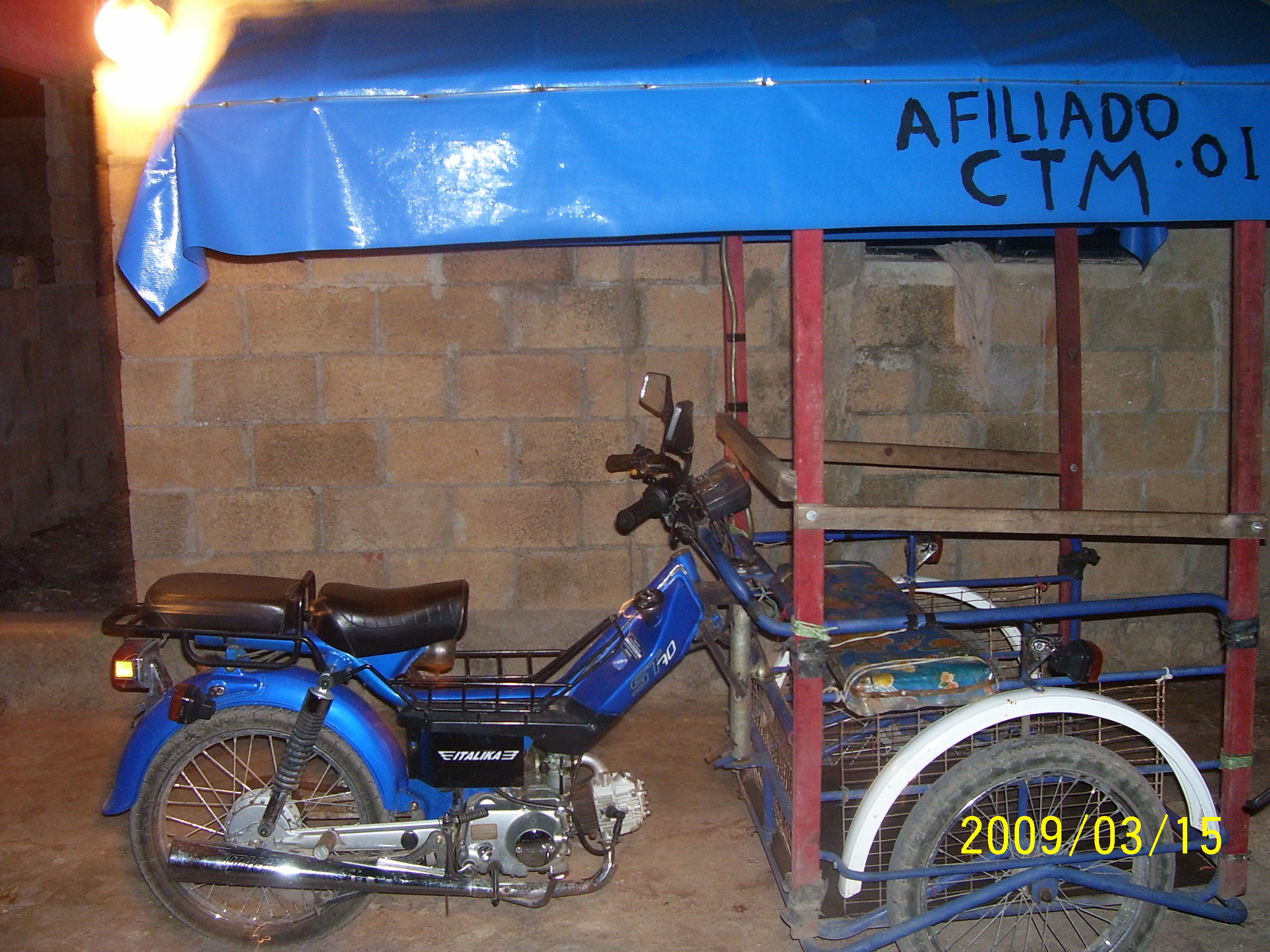
Tricitaxi

My neighbor in Mexico
I have friends in Nebraska, but I’ve only been here four years. I still classify people as “work” friends or “people I know.” For me, it takes much longer than four years to form a strong, real friendship. My friends—the ones I really count on—can be numbered on one hand. They have been through hard times with me, and we have come out stronger for it. People who know me in Virginia or Mexico have a much deeper understanding of who I am than people I’ve met here in my adopted town. I’m not saying anything negative about people here; it simply IS. It takes a long time for me to really trust someone. A gal I know said I have trust issues. Not true. I’m just not stupid or easy to know.
I can call my friends, wherever they may be, and we can start our conversation where we left off before no matter how long it’s been since we chatted. My best friend knows how I drink my coffee, what I think about politics, and how I raise my kids. She also knows how to guard a secret and watch my back. The same things make us laugh. Or cry. She knows my deepest regrets, and she still respects me in spite of my failings. THAT is true friendship.

Friendship takes time!
Ysabela and her friend, Gidalty
An English translation of Yoani Sánchez's blog Generación Y, from Havana, Cuba
Deja tu huella en el mundo
by Bob Moats - Author of Murder Novels
We do product reviews for the intentional family!
Supporting the local community
Fresh Randomness
That's right! I write!
Making learning fun
live, love & laugh lots!
A site to discuss education and democracy
Canine Behavior & Training, Board and Train, Seminars, Private Lessons
Nurse, Wife, Mother, Passionate Home Cook, Joyful Oversharer
@ale_ksandra00
by @dr_dmd
Author and journalist
formerly Charming Farming
 Ramblings of a Perforated Mind